Pooler’s New Impact Fees: Who Really Pays for Growth?
buyer education Trisha Cook November 3, 2026
buyer education Trisha Cook November 3, 2026
I built my first home in Pooler in 1999. What drew me here was affordability and proximity. You could get a lot for your money while staying close to the places you needed to be.
I still invest in Pooler today, both residentially and commercially. That is why I pay attention when decisions can affect the cost of buying a home, renting an apartment or opening a business here.
Pooler’s impact fees raise a practical question: who ultimately carries the cost? The developer may write the first check, but that is not where the conversation should end.
Updated November 4, 2026. The current ordinance PDF lists the residential figures below. An earlier version of this article compared differing published amounts; that comparison no longer reflects the PDF reviewed for this update. Confirm project-specific charges with the City.
The City’s announcement reports adoption on October 19, 2026. Its impact-fee FAQ explains that these one-time development fees help fund infrastructure capacity for growth.
Growth has real costs. Roads, public safety and recreation facilities do not expand for free. Existing residents have a reasonable interest in how new development contributes. Buyers also deserve to understand what that contribution means for the cost of housing.
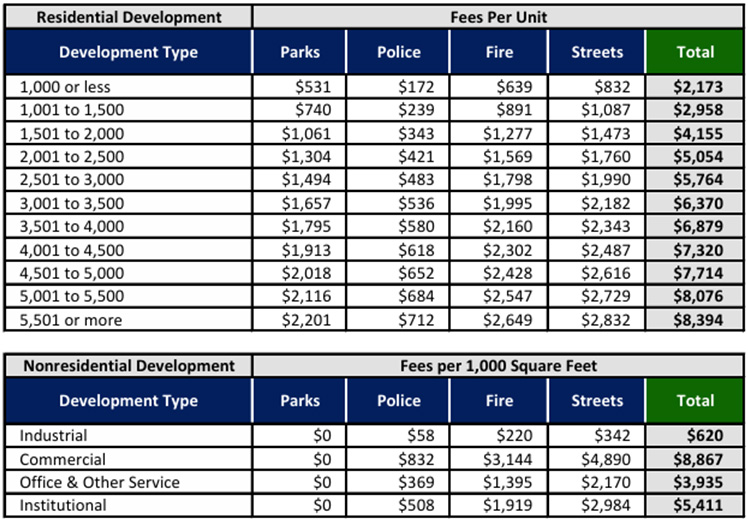
Source: City of Pooler, October 20, 2026 adoption announcement. Select the chart to view it at full size. Use the linked City materials and written project guidance to confirm current applicability.
Page five of the current October ordinance PDF labels its schedule “Maximum Allowable Impact Fees.” It lists these totals for the example home sizes:
Illustrative home size | Published bracket total |
|---|---|
2,400 square feet | $5,054 |
3,000 square feet | $5,764 |
3,300 square feet | $6,370 |
These are schedule examples, not confirmed assessments for a particular permit. The City’s ordinance page still places this PDF under proposed ordinances, although its announcement reports adoption. It also warns that posted documents may differ from their final form. Request written confirmation of the controlling schedule, applicability and any credits or exemptions.
The earlier comparison showed higher figures from a previously reviewed table. The PDF at that link now displays the lower figures above. We should not continue presenting the earlier discrepancy as a current fact.
Builders evaluate the total cost of delivering a project. Added charges can affect asking prices, targeted rents, incentives, profit, land negotiations or whether construction proceeds.
That does not mean each dollar passes directly to a buyer or tenant. Competition and what households can afford also matter. A HUD-sponsored guide to impact fees and housing affordability discusses the tradeoffs between infrastructure funding and housing costs.
My concern is the suggestion that households are insulated simply because a business pays first. They are not automatically insulated, and they are not automatically charged the same amount either.
I raised affordability concerns with city officials in April. Discussion of the largest homes did not answer my question about more typical construction budgets. A policy can charge larger homes more while still adding meaningful costs below the top bracket.
For buyers considering Forest Lakes or Savannah Quarters, the examples above illustrate that point. They are not neighborhood averages, builder quotes or final bills. They show why the conversation should include the home someone is actually considering, rather than focus only on a nearly 5,500-square-foot house.
Existing homeowners should care about future housing options too. That does not mean simply owning an existing home creates a new impact-fee bill.
The developer’s website advertises 1,060 multifamily homes. Multiplying that count by the published schedule’s lowest residential bracket, $2,173, produces $2,303,380.
That is an illustration, not an official assessment or guaranteed minimum. It assumes every advertised unit is subject to that bracket without credits, exemptions or adjustments. Unit sizes, approvals and the controlling schedule matter. Nonresidential uses require separate calculations.
Potential collections should be discussed alongside infrastructure costs and any remaining taxpayer obligations. Gross revenue is not unrestricted profit, and a revenue projection does not establish an official’s reason for voting.
Development costs can put pressure on rents, but fees alone cannot guarantee high rents. New supply, vacancies and household budgets also affect what a property can earn.
Before signing for new construction, ask:
Our Savannah-area new construction guide covers other questions to resolve before committing to a builder contract.
The City reports adoption on October 19, 2026. Confirm when collection applies to your permit separately.
No. The published schedule includes residential and nonresidential categories.
The current PDF lists a $5,764 bracket total. Obtain written City confirmation before treating that as your permit’s charge.
Not necessarily. Costs can affect prices, incentives, profits and project feasibility. Competition also matters.
Continued ownership alone is different from development activity. Confirm treatment of proposed construction or a change of use with the City.
The Trisha Cook Team at Compass can compare available properties, contract questions and ownership costs. Contact our team for a property-specific discussion.
I believe in Pooler, and I want affordability to remain part of its future. If you are comparing a home or investment here, share your plans with The Trisha Cook Team at Compass or call 912-737-2935. We will help you compare the options using current information.
Stay up to date on the latest real estate trends.
buyer education
Compare Hinesville, Richmond Hill, Savannah and Pooler around your actual duty location, housing budget and next move.

Community Guides
Sourced neighborhood options in Savannah, Pooler and Richmond Hill, plus a scheduled River Street event and what to check before heading out.
Selling A Home
A practical Skidaway Island preparation plan: repairs that matter, updates to question, community approvals and the records buyers need.
Community Guides
A practical comparison of original Buckhead and Waterways, from homes and lot sizes to marina access, schools and the daily commute.
buyer education
A local investor’s perspective on housing affordability, conflicting fee schedules and the questions residents should ask.

events
Discover the November 2026 events that make the Lowcountry a wonderful place to live, explore, and call home.

Buying a Home
Two private Hilton Head communities, with different boating setups and practical questions buyers should settle before choosing a home.
Join hands with Savannah’s premier coastal specialists for a real estate experience that’s as unique as you are. Whether buying, selling, or exploring new opportunities, our team is dedicated to guiding you with warmth, and expert insight.